Categories
Uncategorized

Truth-o-meter: Pass/Fail, Live/Die–Connecting School Start Times to Teenage Auto Accidents

What’s up with car accidents and later school start times?

I was homeschooled through every grade before starting college, so I never experienced having to get up early and drive to school on time as a teenager. However, I am interested in the American education system, especially places where it can be improved, so when I found an article discussing school start times I was immediately intrigued.

Today’s fact-check will feature this article: “New study finds association between later school start times and decrease in teen-related car crashes” from ABC News. 

The context for this article is a growing protest from teenagers that school starts too early combined with a clinical hypothesis that those protests are grounded in fact. The idea that schools start too early, causing teens to get less sleep and leading to lower levels of attention and comprehension, is especially alarming when those sleep-deprived teenagers are driving automobiles. This combination has led to more investigation into the matter with a focus on whether or not later school start times can help decrease teen-related auto accidents.

(Both images from Google Images)

Now that some context is established, I’m going to start with move one, checking previous work: looking at other fact-checking sites through DuckDuckGo and seeing what other people have already investigated. Nothing comes up, although I tried various search terms, including: “school start times car accidents” and “school start times Fairfax County”. What I’m looking for is an article from one of our trusty fact-checking sites–Snopes, FactCheck, or Politifact–to see if this claim has already been investigated. No luck. Searching for ABC News using the -abcnews.com format doesn’t glean anything either. 

In that case, let’s move on. I want to know more about ABC News and the author of the article. There are a few places I want to check: Allsides, Google Scholar, and DuckDuckGo one more time for good measure. According to Allsides, ABC News leans left–not quite left, not quite center. I’m not sure how relevant this leaning is though, considering we are nott investigating a widely publicized political issue. There is no author listed for the news article, just ABC News. That lessens our workload a bit.

Using move two and “going upstream”, we can still check the journal and authors of the original study. The study referenced in our article was published in the Journal of Clinical Sleep Medicine.

Move three–“reading laterally”. Is the original source reliable? The Journal of Clinical Sleep Medicine has an impact factor of 3.46. That’s pretty good–what about the authors? According to my Google Scholar search, one of them has been cited over 1000 times, two of them are experts in juvenile medicine, and one specializes in sleep medicine. All of them seem to be reliable and knowledgeable. 

An additional part of this move is to check Wikipedia pages relating to the subject and see if any of their cited sources can help verify my the claim under investigation. I looked at the “Start school later movement” page and the “Waking up early” page. Both of them provided links to several sites that helped me fact-check our claim.

Now to the actual claim! Is there really a correlation between later school start times and less car accidents involving teens? What do other sources say about this claim? 

It seems like the consensus is a resounding affirmative on this point. A DuckDuckGo search reveals the CDC, the American Academy of Sleep Medicine, and the American Academy of Pediatrics all agree teenagers are not getting enough sleep, often because they have to wake up and get ready to start school before 8:30AM.

(Video from YouTube)

Also, although the study we are looking at is from this year, it is apparently not the first study in this vein to be published in the Journal of Clinical Sleep Medicine–there was also one in 2008. This suggests that the issue is not new, not something that was just made up to cause a stir–it is a legitimate issue that researchers have been investigating for over ten years.

(Quote from Google Images)

This was the fastest fact-check I’ve ever done. I went through three of the four moves–checking for previous work, going upstream, and reading laterally. Since this fact-check is still short, I suspect that I’m missing something, so let’s go to step number four and circle back to the original article. Did I neglect anything? Are there points that I still need to address?

I went back to the beginning and started my steps all over again. After checking the news article for new quotes or claims, I tried new searches. I punched in a direct quote from the paragraph quoted below, but I still got nothing for Snopes, Politifact, or FactCheck. 

“Results showed that the crash rate in 16-to-18-year-old licensed drivers decreased significantly from 31.63 to 29.59 accidents per 1,000 drivers after the delayed start time,” the American Academy of Sleep Medicine explained. “In contrast, the teen crash rate remained steady throughout the rest of the state.” 

(ABC News)

Since I’ve found just about everything I need to know about ABC News and the Journal of Clinical Sleep Medicine, I’m going to take some new information and see if there’s a link to the article from 2008 that I mentioned before. There is–and it brings me to the whole article, which is not hidden behind a paywall like the newer one. There are now a few more authors to check out, so back to Google Scholar it is. Just like the first time around, they are experts in adolescent and/or sleep medicine. The articles I got from Wikipedia, from the American Academy of Pediatrics and the National Sleep Foundation, both stress the importance of opening schools later to decrease “drowsy driving” accidents.

To push the limits of this fact check, I want to add a step here–let’s compare, as much as we can, the facts of the two studies. I want to know the who, what, when, where, and why of these studies and how similar their findings were. This might be difficult since I only have access to an abstract for the newer one, but let’s take a look anyway.

For clarity’s sake:

Article 1:

Who: Teenagers in school

What: Sleep times versus accident rates

When: 2013-2017

Where: Fairfax County, Virgina

Why: To see if there was a way to reduce accident rates

Article 2:

Who: Teenagers in school

What: Sleep times versus accident rates

When: 1996-2000

Where: Kentucky

Why: To see if there was a way to reduce accident rates

Both studies found that pushing the time schools started and increasing the amounts of sleep that teenagers were getting visibly reduced accident rates. Both of them had similar time frames, and both included data from before and after the changes were implemented. They compared the rates they found to other rates throughout the state where the changes had not been made, and they each covered a hefty amount of students.

Basically, I can’t find anything to fault in the methods, authors, or publications of either study. The people and groups who are in the know affirm the claims of this research, and I will have to give this fact check on the claim that later school start times are connected to a decrease in teen car accidents is true.

All of my sources are either mentioned or hyperlinked; the rest is my own, original content. Thanks for reading!

Categories
Uncategorized

Stay Away from Going Gray?

What’s up with hair dye and cancer?

Today I want to do a slightly more complicated fact check; we’re looking at an article that involves a reference to a researched study. The one that I chose is from The Washington Post, which discusses a study that suggests a correlation between permanent dye and increased risk of breast cancer, especially in African-American women. A lot of people in my family are cosmetologists or dye their hair a lot, so I’m personally very curious as to whether or not this is true.

The context for this article is the recent trend of women dying their hair gray on purpose. According to the article, even younger women are doing so, following the lead of celebrities like Billie Eilish. 

This YouTube video, published by Faith Robertson, has over 200,000 views.

The article commented on the effects of temporary, semi-permanent, and permanent dye on this risk as articulated to them by experts from the study. The original study, published by The International Journal of Cancer, explored possible connections between hair dye and cancer in white and African-American women, factoring in whether or not they dyed their hair at home or had it professionally done. 

An investigation through DuckDuckGo’s site search feature reveals a Snopes article that covered older studies on the same subject, but nothing on the study mentioned in The Washington Post. It also provides links to government and health sites that discuss whether or not hair dyes cause cancer. 

Moving on to the next step, let’s check out Wikipedia. Some of the information and source links on there led me to more specific definitions of exactly what kind of chemicals were involved in the discussion. Two of the ones mentioned were lead acetate trihydrate and p-Phenylenediamine. They were on the list of potential human carcinogens, but everything I found reported that evidence they cause cancer is inconclusive, and I don’t want to try and explain chemicals that I don’t understand.

Let’s take a moment to read across The Washington Post–how reliable is this source? By looking at the article, I can see at least that they are reporting results fairly consistent with what I noted in the study, that they reference it properly, and that they provide links to more information on it. I don’t appear to be looking at a source that is obviously biased on the subject. No impact factor comes up for this newspaper, but I find mention of Pulitzer Prizes and national recognition–seems like pretty solid writing. Just to be sure, I kept looking. Apparently The Washington Post was recently purchased by a company owned by Jeff Bezos, which may be something to keep in mind. However, Statista, Encyclopaedia Britannica, and MediaBias FactCheck, all sources I consider fairly reliable, create a consensus that agrees The Washington Post is usually factual and credible.

Checking out the author and the journal is vital. The International Journal of Cancer has an impressive impact factor of 7.36, and each of the listed authors have multiple articles published in related medical or research fields. This leads me to believe that they know what they’re talking about. 

Finally, I went upstream on the source from the original article and examined the study that was mentioned. I only understand some of it, obviously, but it is useful nonetheless. It provided a link to an organization from which the study participants were gleaned, but most importantly it gives me the original claims made and their hypothetical state. The abstract states that they did find correlations between use of hair dye and breast cancer risk, although they use equivocal language to indicate that these findings are not concrete evidence of the dangers of semi-permanent and permanent hair dyes.

At this point, I think I’ve compiled enough information to determine what the consensus is on this claim. The journal is reliable, the authors are reliable, the newspaper is reliable, so we can say with some certainty that we aren’t looking at a scam. The original study, combined with this boost of trustworthiness, is in agreement with government and health departments that make no finalized claims about the dangers of hair dyes, but do strongly suggest that users remain wary, and that more research be completed. So–if you’re thinking about going gray, or red, or purple, or teal ombre, or whatever other color you can come up with, check out the ingredients on the box, and seek a professional cosmetologist.

All of my sources are either mentioned or hyperlinked. Thanks for reading!

Categories
Uncategorized

Caucus Hocus Pocus–Were the Iowa Caucus Results Hidden?

What’s up with the Iowa Caucus results?

On Saturday morning, CNN Politics put out an article with the headline claim “Iowa’s mess is a threat to democracy”. For a fact-checker, this article is a gold mine. There are numerous claims that could be explored, but the most direct and intriguing is that “The Iowa Democratic Party made things worse by hiding the issue behind its delayed results for hours on Caucus night. Then, it released only a portion of results.” Politifact gave a similar claim a “false” rating, but let’s explore this claim for ourselves and see if we can determine its level of veracity.

First, where and why did this article get published? I encountered this article on Google News, but it could also be found on other news conglomerates, and the CNN website, TV channel, or other affiliations. The Iowa Caucus was a pivotal moment in the timeline of the Democratic side of the upcoming election. When it was released last week that there were complications with the voting results and the app that was used to calculate the ballots, there was national concern. Debate and conspiracies sparked about the origin of the issues and whether or not there was malicious intention involved on the part of the Democratic Party. 

It would also be a good idea to check out the author of the article that makes the claim, Zachary B. Wolf. Preliminary research on DuckDuckGo shows he is a longtime political journalist. A lot of his pieces are analyses, allowing a bit of the author’s bias to show through, but based on this reading he does not seem to allow his views to overtake his work, although they may provide a sheen of skepticism about the honesty of politicians. 

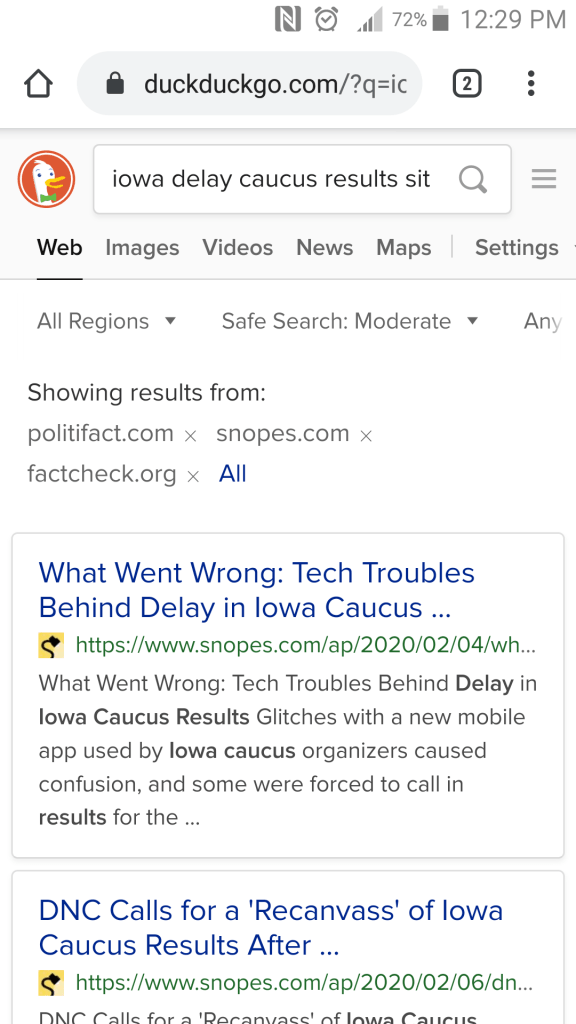
After investigating the author’s background, I did some searching on DuckDuckGo using the site search option. I found several articles on Snopes and Politifact that I used to dig a little deeper. Wikipedia backtracking provided links to related news articles, the actual results (which unfortunately and ironically did not open due to an error) and a glimmer of truth. Articles from The New York Times and other big news outlets, along with the investigations from the fact-checking sites confirm: the results of the Caucus were delayed. However, it’s a bit of a stretch to say that the issue was hidden. While the Iowa Democratic Party did not release the name of the company behind the app they were using, the information was available to the media and the public in other ways. This fact-check is really a matter of wordplay. The claims are essentially true: yes, the results were delayed, yes, only some results were initially released. The information could be worded and interpreted in various ways, so this particular fact-check is a draw. The facts are right, the wording could be a bit biased, but there is no conclusive proof of misinformation. 

This fact-check is really a matter of wordplay. The claims are essentially true: yes, the results were delayed, yes, only some results were initially released. The information could be worded and interpreted in various ways, so this particular fact-check is a draw. The facts are right, the wording could be a bit biased, but there is no conclusive proof of misinformation. 

Before we abandon this discussion, let’s take a closer look at my sources. Here are the prevalent articles I read:

https://www.cnn.com/2020/02/08/politics/us-democracy-future-iowa-caucuses/index.html

https://www.politifact.com/factchecks/2020/feb/04/organizers-bernie-2020/no-evidence-iowa-poll-or-caucus-were-blocked-democ/

https://www.politifact.com/article/2020/feb/04/what-we-know-about-shadow-acronym-and-iowa-caucuse/

https://en.wikipedia.org/wiki/2020_Iowa_Democratic_caucuses

The articles from Politifact served both to give an unbiased overview of the situation and debunk the idea that the Iowa Democratic Party was hiding results. They also provided information on the software side of the issue, which is a discussion for another post. The Wikipedia page on the Iowa Caucus was not as helpful as the encyclopedia was during my first blog post, but it helped to convince me that the truth was more complicated than the original CNN article suggested. 

That’s the verdict. Delayed results does not mean deliberate dishonesty, but it does leave some lingering questions about digital integration into our voting methods. What is the best way to vote in the modern era?

All of my sources are either mentioned or hyperlinked, and the rest is my own original content. Thanks for reading!

Design a site like this with WordPress.com
Get started